
Strategies for inquiry based learning: 7 approaches
Unlock strategies for inquiry based learning: 9 actionable methods to spark curiosity and critical thinking.
In a world overflowing with information, the ability to ask meaningful questions is more valuable than the ability to simply recall answers. The traditional model of education, where students are passive recipients of knowledge, is giving way to a more dynamic, engaging approach: inquiry-based learning. This educational philosophy transforms learners from spectators into active participants in their own discovery process. It’s about fostering curiosity, encouraging critical thinking, and empowering students to construct their own understanding by exploring questions, problems, and scenarios.
This comprehensive guide moves beyond theory to provide a practical toolkit of strategies for inquiry based learning. We will explore nine distinct, actionable approaches that you can implement to ignite curiosity and deepen comprehension. Each strategy is designed to shift the focus from rote memorization to meaningful exploration, ensuring students not only learn content but also develop essential lifelong skills like problem-solving, collaboration, and analytical reasoning.
Within this roundup, you will find a detailed breakdown of each method, including:
- Step-by-step implementation guides for classroom or group settings.
- Practical assessment tips to measure understanding effectively.
- Sample activities and lesson outlines to get you started immediately.
- Specific examples demonstrating how a tool like the geography game EarthChasers can be used to support and enhance each inquiry model.
Whether you are an educator, a trivia enthusiast, or a gamer passionate about learning, this article provides the concrete strategies needed to cultivate a true spirit of inquiry. Prepare to explore techniques ranging from Problem-Based Learning and the Socratic Method to Community-Based Inquiry, all designed to build a more engaging and effective learning environment.
1. Strategy 1: Question-Based Inquiry Learning
Question-Based Inquiry Learning is a foundational strategy where the entire learning process is propelled by questions. Instead of teachers delivering facts for memorization, students actively formulate and investigate questions, transforming them from passive recipients into active constructors of knowledge. This approach places the art of questioning at the very core of the educational experience.
The process begins with a central, compelling question, which can be posed by the teacher (structured inquiry) or developed by the students themselves (open inquiry). This initial spark ignites curiosity and provides a clear direction for investigation. As students delve deeper, they generate their own sub-questions, guiding their research, experiments, and discussions. This is a core component of effective strategies for inquiry based learning, as it fosters critical thinking and intellectual autonomy.
Implementation in the Classroom
To successfully implement this strategy, focus on creating an environment where curiosity is valued and questioning is encouraged.
- Start with a "Wonder Wall": Dedicate a space in the classroom where students can post questions about a new topic. This visual collection becomes a roadmap for the unit's exploration.
- Teach Question Formulation: Use frameworks like the "Question Formulation Technique" (QFT) to guide students in crafting both open-ended (divergent) and closed-ended (convergent) questions. Differentiate between "thick" questions that require deep analysis and "thin" questions that can be answered with a simple fact.
- Structure the Investigation: Provide resources and a framework for students to find answers. This could involve curated articles, lab stations, expert interviews, or digital tools. The goal is to facilitate their search, not to provide the answers directly.
Using EarthChasers to Support this Strategy
The EarthChasers trivia game is an excellent tool for stimulating Question-Based Inquiry. After a game round focused on a specific region, like the Amazon Rainforest, a teacher can leverage the game's content to spark deeper questions.
For example, a question about Brazil’s deforestation rates might lead a student to ask, "What are the main economic drivers of deforestation in the Amazon?" This student-generated question becomes the starting point for a research project, moving far beyond the initial trivia fact. A teacher can then challenge the student to create a new, more complex EarthChasers question based on their findings, completing the inquiry cycle.
2. Problem-Based Learning (PBL)
Problem-Based Learning (PBL) flips the traditional "learn then apply" model on its head. In this strategy, students are presented with a complex, open-ended, real-world problem before they receive any direct instruction on the topic. The problem itself becomes the vehicle for learning, compelling students to identify knowledge gaps and seek out the information needed to develop a viable solution.
This approach transforms the learning process into a mission-driven investigation. Instead of memorizing isolated facts, students learn content within the context of its application, fostering deeper understanding and long-term retention. PBL is one of the most effective strategies for inquiry based learning because it inherently requires students to ask questions, conduct research, collaborate, and apply knowledge, mirroring the process professionals use to solve challenges in their fields.
Implementation in the Classroom
To implement PBL, the focus is on presenting an authentic problem and guiding students through a structured solution-finding process.
- Present an Authentic Scenario: Begin with a "messy" problem that has no single correct answer. For example, present students with data on local water quality and challenge them to design a community action plan to reduce pollution.
- Follow a Structured Cycle: Guide students through a PBL cycle. A common model includes analyzing the problem, defining learning objectives (what we need to know), conducting independent and group research, synthesizing findings, proposing a solution, and reflecting on the process.
- Act as a Facilitator: The teacher's role shifts from a "sage on the stage" to a "guide on the side." Provide resources, ask probing questions to deepen thinking, and offer scaffolding, especially for students new to PBL.
Using EarthChasers to Support this Strategy
The EarthChasers game can serve as an excellent launchpad for a PBL unit. A game focusing on global food production might reveal a startling fact about food deserts in a particular urban area. This single piece of trivia becomes the hook for a complex problem.
The teacher can frame the challenge: "Given what we know about food insecurity from EarthChasers, how could we design a sustainable solution to increase access to fresh food in a neighborhood within our own city?" Students must then research urban agriculture, logistics, economics, and community needs to develop a comprehensive proposal. This process cultivates vital skills in collaborative problem solving, turning a simple game fact into a powerful, project-based learning experience.
3. Strategy 3: Discovery Learning
Discovery Learning is a powerful inquiry-based approach where students construct their own understanding by actively exploring concepts through hands-on experiences and experimentation. Instead of receiving information directly from a teacher, learners engage with materials, problems, and environments to uncover principles and solutions on their own. This strategy, heavily influenced by the work of theorists like Jerome Bruner and Jean Piaget, positions the teacher as a facilitator who creates a rich learning landscape rather than a lecturer who dispenses facts.
The core of this method is the belief that genuine understanding comes from personal discovery. Students are encouraged to manipulate objects, engage in simulations, and conduct experiments to see relationships and patterns for themselves. As one of the most hands-on strategies for inquiry based learning, it transforms abstract concepts into tangible experiences, fostering deep conceptual knowledge and a strong sense of ownership over the learning process.
Implementation in the Classroom
To implement Discovery Learning, the focus is on creating a prepared environment that invites exploration and provides the necessary tools for students to make connections.
- Provide a Rich Environment: For a biology unit on ecosystems, this might mean setting up terrariums or stream tables. For a physics lesson on circuits, it would involve providing batteries, wires, bulbs, and switches with minimal initial instruction.
- Use Guiding Questions: Instead of providing answers, ask open-ended questions to steer exploration. For example, "What happens when you connect the wires differently?" or "What patterns do you notice in the water flow?"
- Allow Time for Exploration: Discovery takes time. Build unstructured or semi-structured exploration periods into your lesson plans, allowing students to experiment, fail, and try again without the pressure of immediate correctness.
- Facilitate a Debrief: After exploration, guide a whole-class discussion where students share their findings, articulate the principles they discovered, and correct any misconceptions with peer and teacher support.
Using EarthChasers to Support this Strategy
The EarthChasers trivia game can serve as an excellent catalyst for Discovery Learning. A game round featuring questions about plate tectonics and volcanoes can set the stage for a hands-on discovery activity. A teacher could provide students with maps of earthquake and volcano locations, topographical maps, and continental plates.
Without giving them the answer, the teacher can pose a challenge: "Using these maps, can you discover the relationship between these geological features?" Students would then physically overlay the maps or use digital tools to discover for themselves that volcanoes and earthquakes are concentrated along plate boundaries. This active process of discovery turns a trivia fact into a deeply understood geological principle. For more insights on this hands-on approach, you can explore this post on interactive learning.
4. Project-Based Learning (PBL)
Project-Based Learning (PBL) is an extended inquiry strategy where students engage in a sustained, in-depth investigation of a complex, real-world challenge. Unlike shorter inquiry cycles, PBL involves students working over an extended period, often weeks or even a full semester, to create a tangible product, presentation, or performance as the culmination of their learning. This method emphasizes both content mastery and the development of critical skills like collaboration, communication, and problem-solving.
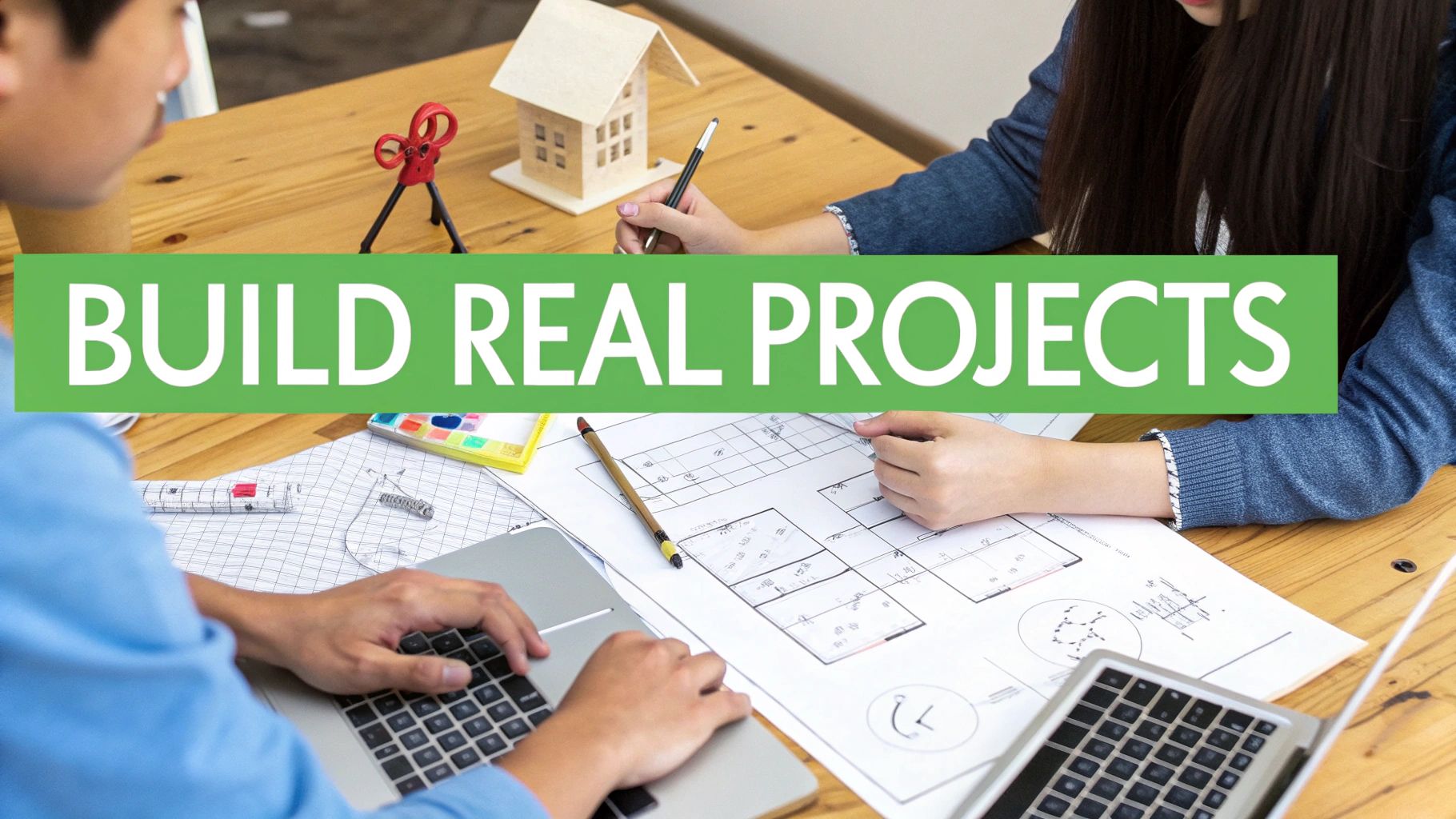
The process is anchored by a compelling driving question or problem, such as "How can we design a sustainable neighborhood for our city?" Students then embark on a journey of sustained inquiry, research, and creation to answer it. This approach is one of the most comprehensive strategies for inquiry based learning because it requires students to manage long-term goals, integrate feedback, and present their work to an authentic audience, mirroring professional, real-world challenges.
Implementation in the Classroom
Successfully implementing PBL requires careful planning to balance student autonomy with clear learning objectives. The collaborative nature of these projects offers a powerful way to integrate various social learning examples into your curriculum.
- Launch with a Compelling Entry Event: Start the project with an engaging experience, like a guest speaker, a field trip, or a provocative video, to spark curiosity and establish the project's real-world relevance.
- Establish Clear Objectives and Rubrics: From the outset, provide students with clear learning goals and detailed rubrics that assess both the final product and the skills developed throughout the process (e.g., collaboration, critical thinking).
- Build in Feedback and Revision: Structure the project timeline to include regular check-ins, peer feedback sessions, and opportunities for revision. This iterative process is crucial for deep learning and high-quality work.
- Connect to an Authentic Audience: Arrange for students to present their final products to people outside the classroom, such as community members, industry professionals, or other students, to give their work real-world purpose.
Using EarthChasers to Support this Strategy
EarthChasers can serve as an excellent catalyst for a PBL unit. For instance, a game session highlighting global climate patterns and environmental hotspots could introduce a driving question: "How can our local community contribute to solving a global climate challenge?"
Students could use the game's geographical data as a starting point for their initial research, identifying a specific issue like water scarcity or habitat loss. Their project could involve designing a community action plan, creating an educational campaign, or engineering a small-scale solution. The final product might be a presentation to the city council or a documentary film, showcasing a deep, inquiry-driven understanding of geography and environmental science far beyond simple trivia recall.
5. Guided Inquiry
Guided Inquiry serves as a crucial bridge between highly structured, teacher-led instruction and completely open, student-driven exploration. In this model, the teacher provides the initial question, topic, and necessary resources, but students determine the procedure and process for reaching a conclusion. This approach scaffolds the learning experience, offering essential support while preserving student agency and critical thinking.
This strategy is one of the most versatile strategies for inquiry based learning because it balances freedom with focus. Teachers guide students toward specific learning objectives by curating materials and providing a framework, preventing the overwhelm that can sometimes accompany pure discovery learning. Popularized by educational researchers like Carol Kuhlthau, this method ensures students develop core research skills within a supportive and purposefully designed environment. For a deeper look at creating these types of supportive educational environments, you can learn more about the principles behind student-centered learning.
Implementation in the Classroom
Successfully implementing Guided Inquiry involves creating a structured yet flexible pathway for students to follow. The goal is to provide just enough support to keep them on track without dictating their every move.
- Utilize the 5E Model: Structure your lessons using the Engage, Explore, Explain, Elaborate, and Evaluate sequence. This proven framework naturally guides students through the inquiry process, from initial curiosity to demonstrated understanding.
- Provide Research Templates: Offer graphic organizers or digital templates that help students structure their research. These tools can guide them in gathering evidence, analyzing sources, and formulating conclusions without prescribing what those conclusions should be.
- Employ Question Progressions: Start with foundational, lower-order questions to build a knowledge base, then gradually introduce more complex, higher-order thinking questions that require analysis, synthesis, and evaluation. This models the inquiry process and builds student confidence.
Using EarthChasers to Support this Strategy
The EarthChasers game can serve as the "Engage" phase of a Guided Inquiry lesson. A teacher can present a specific, curated set of game questions related to a single topic, such as "Water Scarcity in North Africa."
After the game, the teacher poses a broad guiding question: "What are the most significant factors contributing to water scarcity in North Africa, and what is one innovative solution being implemented?" Students are then provided with a curated set of resources-articles, data sets from the World Bank, and documentaries. They use these materials to investigate the question, analyze information, and present their findings. This method uses the game's content as a launchpad for a focused, teacher-guided investigation.
6. Case Study Inquiry
Case Study Inquiry is a strategy that immerses students in the detailed analysis of real or realistic scenarios to explore complex concepts and develop problem-solving skills. Instead of learning abstract theories, students investigate a specific "case," such as a historical event, a business dilemma, or a scientific phenomenon. They dissect the situation, identify key issues, analyze data, and propose solutions or conclusions.
This method transforms learners into investigators, requiring them to apply theoretical knowledge to a tangible context. The process starts with a carefully selected case that embodies the core principles of a topic. Students then work through the case, often collaboratively, to understand its nuances and implications. This is one of the most effective strategies for inquiry based learning because it bridges the gap between classroom knowledge and real-world application, fostering deep analytical and critical thinking skills.
Implementation in the Classroom
To implement this strategy effectively, the focus should be on selecting compelling cases and structuring the analytical process to guide student discovery.
- Select Rich Cases: Choose cases that are complex, contain a central dilemma or tension, and offer multiple perspectives. A case about a real-world environmental pollution incident, for instance, should include scientific data, community testimonials, and corporate statements.
- Provide a Framework: Give students a structured guide for their analysis. This could include a set of guiding questions, a graphic organizer for identifying stakeholders and their motives, or a problem-solving model to follow.
- Facilitate Structured Discussion: Use protocols like a "Socratic Seminar" or "Chalk Talk" to ensure discussions are productive and inclusive. The goal is to encourage students to build on each other's insights, challenge assumptions, and synthesize diverse viewpoints to form a comprehensive understanding.
Using EarthChasers to Support this Strategy
The EarthChasers game can serve as an excellent entry point for a Case Study Inquiry. A game focused on global economies might feature a trivia card about the 2008 financial crisis in Iceland. This single fact can become the anchor for an in-depth case study.
A teacher could present the class with the case: "How did a small island nation like Iceland become a global financial hub and then face a catastrophic collapse?" Students would then investigate the economic policies, banking practices, and global factors involved. They could analyze data on Iceland’s GDP, read articles about its "Pots and Pans Revolution," and debate the ethical decisions made. The initial EarthChasers fact thus blossoms into a rich, multi-faceted inquiry into economics, politics, and social geography.
7. Scientific Inquiry / Experimental Inquiry
Scientific Inquiry, also known as Experimental Inquiry, is a systematic strategy where students directly engage in the authentic practices of science. It moves beyond learning scientific facts to understanding the scientific process itself. Students learn to develop testable questions, design and conduct controlled experiments, meticulously collect data, analyze their results, and draw evidence-based conclusions that they can defend.
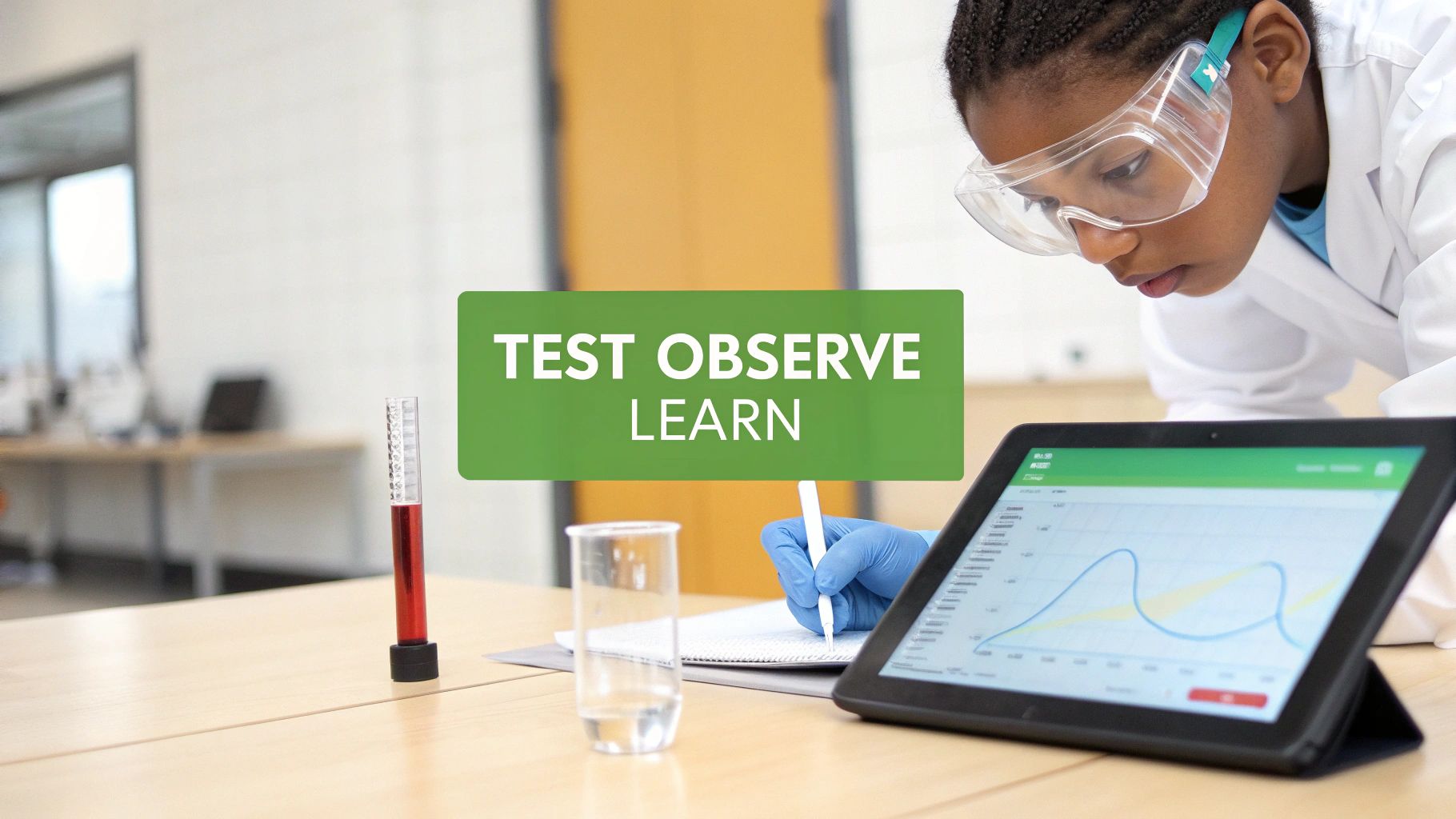
This approach immerses students in the mindset of a scientist, emphasizing the critical importance of empirical evidence, reproducibility, and peer review. It’s one of the most hands-on strategies for inquiry based learning, teaching not just content but also the methodical thinking and problem-solving skills inherent to scientific discovery. This process is fundamental to how we build reliable knowledge about the natural world.
Implementation in the Classroom
To successfully implement this strategy, the focus is on creating a safe and structured environment for experimentation where students learn from all outcomes, not just the expected ones.
- Explicitly Teach Experimental Design: Dedicate time to teaching core concepts like independent, dependent, and controlled variables. Guide students in formulating a clear, testable hypothesis.
- Embrace 'Failed' Experiments: Frame unexpected results or experimental errors not as failures but as valuable learning opportunities. This encourages resilience and teaches students the iterative nature of scientific investigation.
- Analyze and Conclude with Evidence: Guide students to use their collected data to support their conclusions. For those engaging in Scientific / Experimental Inquiry, understanding foundational statistical methods like hypothesis testing in statistics is often crucial for data analysis and drawing valid conclusions.
- Promote Peer Review and Presentation: Have students present their findings to their peers, who can ask questions and critique the methodology. This mirrors the real-world scientific community and reinforces communication skills.
Using EarthChasers to Support this Strategy
The EarthChasers trivia game can serve as a powerful catalyst for Scientific Inquiry, particularly in subjects like Earth science and environmental studies.
Embedded content
For instance, a game question about the effect of volcanic eruptions on global temperatures could spark a classroom investigation. Students could then be challenged to design a small-scale experiment modeling the "volcanic winter" effect. They might formulate a hypothesis like: "Adding fine ash particles to a sealed, light-exposed container will cause its internal temperature to drop compared to a control container." This simple experiment allows them to test a concept from the game, collect data, and draw conclusions, directly applying the principles of Scientific Inquiry.
8. Socratic Inquiry / Socratic Method
Socratic Inquiry, also known as the Socratic Method, is a disciplined form of dialogue centered on asking and answering strategic questions. Rather than providing direct answers, the teacher acts as a facilitator, guiding students through a series of probing questions that help them examine their own beliefs, challenge assumptions, and arrive at a more profound understanding on their own. This ancient pedagogical approach transforms learning from a passive reception of information into an active process of critical examination and self-discovery.
The core of this method is the belief that knowledge is discovered, not transmitted. A teacher initiates a discussion with a thoughtful, open-ended question. As students respond, the teacher asks follow-up questions that require them to clarify their statements, consider counterexamples, and explore the logical implications of their thoughts. This makes Socratic Inquiry one of the most powerful strategies for inquiry based learning for developing reasoning skills and surfacing deep-seated misconceptions.
Implementation in the Classroom
To effectively use the Socratic Method, the focus must be on creating a safe, collaborative environment where students feel comfortable exploring and defending their ideas.
- Plan Your Questioning Arc: Before a discussion, map out a logical sequence of questions. Start with broad, foundational questions and prepare follow-up probes that will push students to delve deeper into the topic, such as "Why do you believe that is true?" or "What would be an example of that?"
- Embrace Strategic Silence: After asking a question, allow for ample "think time." Silence can feel uncomfortable, but it is a crucial tool that gives students the mental space needed to formulate thoughtful, well-reasoned responses instead of rushed, superficial ones.
- Focus on the Process, Not the Answer: The goal is not for students to arrive at a single "correct" answer dictated by the teacher. Instead, the objective is to model and practice the process of critical thinking, logical reasoning, and evidence-based argumentation.
Using EarthChasers to Support this Strategy
The EarthChasers trivia game provides a perfect launchpad for a Socratic seminar. A game focused on global economies might present a fact about the GDP of a particular country, which can serve as the initial prompt for a deeper inquiry.
For instance, after a question about Switzerland's high GDP, a teacher could begin a Socratic discussion by asking, "What makes a country 'wealthy'?" Student answers might focus on money or resources. The teacher could then follow up with questions like, "Can a country be wealthy in resources but have a poor population? Why?" and "Does a high GDP always mean a high quality of life for all citizens? What evidence supports your view?" This line of questioning guides students to deconstruct complex concepts like wealth and economic indicators, moving them from a simple fact to a nuanced understanding.
9. Community-Based Inquiry and Service Learning
Community-Based Inquiry and Service Learning grounds the learning process in real-world local issues, transforming students into active citizens. This approach moves beyond the classroom walls, empowering students to investigate authentic community challenges and then take meaningful action to address them. The inquiry is not just academic; it is driven by a genuine need and culminates in service that benefits the community.
This strategy merges academic standards with civic responsibility. The process begins with identifying a genuine community need, such as food insecurity, environmental pollution, or lack of accessible public spaces. Students then conduct in-depth research, collaborate with community partners, and design and implement a service project to address the identified issue. This is one of the most impactful strategies for inquiry based learning because it makes learning relevant and demonstrates to students their own agency in creating positive change.
Implementation in the Classroom
To implement this strategy, the focus is on building authentic relationships and ensuring the project is mutually beneficial for both students and the community.
- Forge Genuine Partnerships: Reach out to local non-profits, government agencies, or community leaders. Build relationships based on respect and a shared goal, ensuring the community's voice is central to the project.
- Balance Action and Reflection: The "service" is just one component. Dedicate significant time to the inquiry phase (researching root causes) and the reflection phase (analyzing the impact and systemic issues) to ensure deep learning occurs.
- Connect to Curriculum: Explicitly map the project's activities and learning outcomes to specific academic standards in social studies, science, language arts, and other subjects. This ensures the project has clear academic rigor.
Using EarthChasers to Support this Strategy
The EarthChasers trivia game can serve as an excellent catalyst for identifying local issues with global parallels. A game round focusing on global food production or water scarcity could spark an inquiry into similar challenges within the students' own community.
For instance, a question about agricultural practices in the Great Plains might lead students to ask, "Where does our own community's food come from?" This question could launch a community-based inquiry into local food deserts or the challenges faced by local farmers. Students could then partner with a food bank to develop a community garden, directly applying their learning. Their final project could even involve creating a new EarthChasers "Community Changemakers" deck focused on local solutions to global problems.
Comparison of 9 Inquiry-Based Learning Strategies
| Title | Implementation Complexity (🔄) | Resource Requirements (⚡) | Expected Outcomes (⭐ / 📊) | Ideal Use Cases (📊) | Key Advantages (⭐) | Tip (💡) |
|---|---|---|---|---|---|---|
| Question-Based Inquiry Learning | Moderate — needs question scaffolding and facilitation | Low–Moderate — research materials and time | ⭐⭐⭐⭐ — deeper understanding, critical thinking, metacognition | Introductory inquiries, classroom units, formative exploration | Encourages curiosity and student ownership of learning | Start with structured question stems and document the inquiry |
| Problem-Based Learning (PBL) | High — requires curriculum redesign and teacher training | High — complex problems, time, possible expert involvement | ⭐⭐⭐⭐ — higher-order thinking, collaboration, real-world problem solving | Professional programs, interdisciplinary real-world challenges | Strong real-world relevance and teamwork development | Use a clear PBL cycle and provide scaffolding for learners |
| Discovery Learning | Moderate–High — teacher prepares open environments and monitors | Moderate–High — varied materials and flexible spaces | ⭐⭐⭐ — deep, experiential learning but risk of misconceptions | Early childhood, exploratory labs, concept discovery | Promotes independence, intrinsic motivation, hands-on learning | Provide rich materials, guide with questions, debrief discoveries |
| Project-Based Learning (PBL) | High — long-term planning, coordination, assessment design | High — extended time, materials, audience connections | ⭐⭐⭐⭐ — 21st-century skills, sustained mastery, portfolios | Capstone projects, interdisciplinary units, community projects | Produces tangible outcomes and sustained student engagement | Launch with a driving question and use rubrics for process/product |
| Guided Inquiry | Moderate — structured frameworks and responsive teaching required | Moderate — templates, datasets, scaffolds | ⭐⭐⭐⭐ — efficient learning with maintained inquiry and standards alignment | Standards-aligned units, mixed-ability classrooms, skill building | Balances structure and student agency; easier to align to standards | Use 5E model, graphic organizers, and gradually remove scaffolds |
| Case Study Inquiry | Moderate — needs well-designed cases and skilled facilitation | Low–Moderate — curated cases, prep time | ⭐⭐⭐⭐ — analytical reasoning, application to realistic contexts | Law, business, medicine, social sciences, ethics discussions | Connects theory to practice and builds argumentation skills | Select high-quality cases and use structured discussion protocols |
| Scientific / Experimental Inquiry | High — requires experimental design skills and safety management | High — lab equipment, consumables, time, safety resources | ⭐⭐⭐⭐ — mastery of scientific method, data literacy, evidence-based reasoning | Science labs, research projects, NGSS-aligned investigations | Teaches authentic scientific practices and measurement skills | Teach controls/replication; begin with structured experiments |
| Socratic Inquiry / Socratic Method | Moderate–High — relies on teacher questioning skill and classroom norms | Low — primarily teacher time and preparation | ⭐⭐⭐⭐ — advanced reasoning, argumentation, metacognitive awareness | Seminars, humanities, Socratic seminars, critical discussion classes | Fosters deep critical thinking through dialogue and reflection | Ask open-ended probes, allow think time, cultivate psychological safety |
| Community-Based Inquiry & Service Learning | High — coordination, partnership building, and logistics | High — community contacts, time, possible costs and liability planning | ⭐⭐⭐⭐ — civic skills, social awareness, tangible community impact | Civic education, service-learning projects, community partnerships | Integrates academic learning with real-world civic engagement | Build reciprocal partnerships, center community voice, reflect on equity |
Putting Inquiry into Practice: Your Next Steps
Summarize Key Insights
Here is a quick review of the nine core strategies for inquiry based learning we’ve explored:
- Question-Based Inquiry - Start with a compelling question that sparks curiosity and guides student-led research.
- Problem-Based Learning - Present authentic challenges so learners apply critical thinking to solve real issues.
- Discovery Learning - Encourage exploration and self-directed discovery through hands-on experimentation.
- Project-Based Learning - Design cross-disciplinary projects that result in tangible products or presentations.
- Guided Inquiry - Offer scaffolded support as students follow structured phases toward independent inquiry.
- Case Study Inquiry - Use detailed scenarios to cultivate analytical skills and evidence-based reasoning.
- Scientific Inquiry - Teach the scientific method through hypothesis testing, data collection, and analysis.
- Socratic Inquiry - Facilitate disciplined group dialogue that deepens understanding through probing questions.
- Community-Based Inquiry - Connect classroom learning to local needs via service projects and fieldwork.
“Inquiry based learning transforms classrooms into dynamic laboratories of thought where students become active knowledge creators.”
Consolidated Takeaways
- Learner Ownership: Empower students by placing them at the center of question formulation and investigation.
- Scaffolded Growth: Gradually withdraw support to build independence without sacrificing success.
- Contextual Relevance: Tie every activity to real-world geography, culture, or environmental issues.
- Collaborative Culture: Foster teamwork through peer review, group problem solving, and shared presentations.
- Ongoing Reflection: Embed short debriefs and self-assessment checkpoints after each inquiry phase.
Actionable Next Steps
- Define Clear Objectives: Map each strategy for inquiry based learning to specific skills and standards.
- Prototype One Strategy: Pilot a single approach—such as a discovery lab or case study inquiry—to test logistics.
- Leverage EarthChasers: Integrate EarthChasers quests to reinforce geographic inquiry and gamify exploration.
- Collect Student Feedback: Use quick surveys or exit tickets to gauge engagement and identify pain points.
- Iterate and Expand: Refine your lesson flow, then scale successful modules across additional topics.
Bringing It All Together
When you weave together these research-backed strategies for inquiry based learning, you create a dynamic ecosystem where curiosity leads classroom design. Each method complements the others: questions fuel projects, projects demand collaboration, and collaboration fosters deeper questioning. By mixing and matching approaches—guided inquiry one week, community-based inquiry the next—you keep learners motivated and on a continuous upward trajectory.
Why Mastering These Strategies Matters
Implementing varied inquiry frameworks cultivates not only academic mastery but also real-world competencies. Students gain confidence when they see their questions evolve into meaningful projects. They develop critical thinking, data literacy, and communication skills that extend beyond geography or science. Ultimately, inquiry based learning equips them for lifelong learning and civic engagement in a rapidly changing world.
Your Journey Starts Now
Remember that inquiry based learning is not a one-size-fits-all solution; it’s a cycle of probing, exploring, reflecting, and adapting. Embrace experimentation in your classroom, celebrate small victories, and view every setback as a valuable data point. Keep your own curiosity alive by asking which strategies resonate most with your students, then refine your practice accordingly.
Every great discovery begins with a simple question. What will your next question be?
Call to Action
Ready to elevate your strategies for inquiry based learning with immersive geography challenges? Explore EarthChasers to access interactive quests that turn every lesson into a real-world expedition. Visit EarthChasers to spark curiosity and deepen student engagement today!