
What Is Game Based Learning and How Does It Work
What is game based learning? Discover how this powerful educational strategy uses games to boost engagement, improve retention, and make learning fun.
In simple terms, game-based learning (GBL) is an educational approach that uses a full-fledged game to teach a specific skill or idea. The learning goals are woven directly into the game's story, its rules, and the challenges you face, making the lesson and the gameplay one and the same.
Defining Game Based Learning
Think about learning to fly a plane. You wouldn't just read a textbook in a real cockpit; you’d start with a flight simulator. That simulator is a perfect stand-in for game-based learning. It’s an interactive, controlled space where you learn by doing, making mistakes, and getting instant feedback—all while aiming for a clear goal. The point isn't just entertainment; it's to master the very real skills of flying through direct experience.
GBL puts the learner in a similar position. Instead of passively soaking up information, students are actively engaged in a system with clear rules and objectives. This method makes abstract concepts feel concrete and turns theoretical knowledge into skills you can actually use. Its effectiveness is reflected in its rapid growth; the global GBL market hit USD 21.3 billion and is expected to soar to USD 80.0 billion by 2033.
The Core Components of GBL
At its heart, every great learning game is built on purposeful design. The learning isn't just sprinkled on top—it's the foundation of the entire experience.
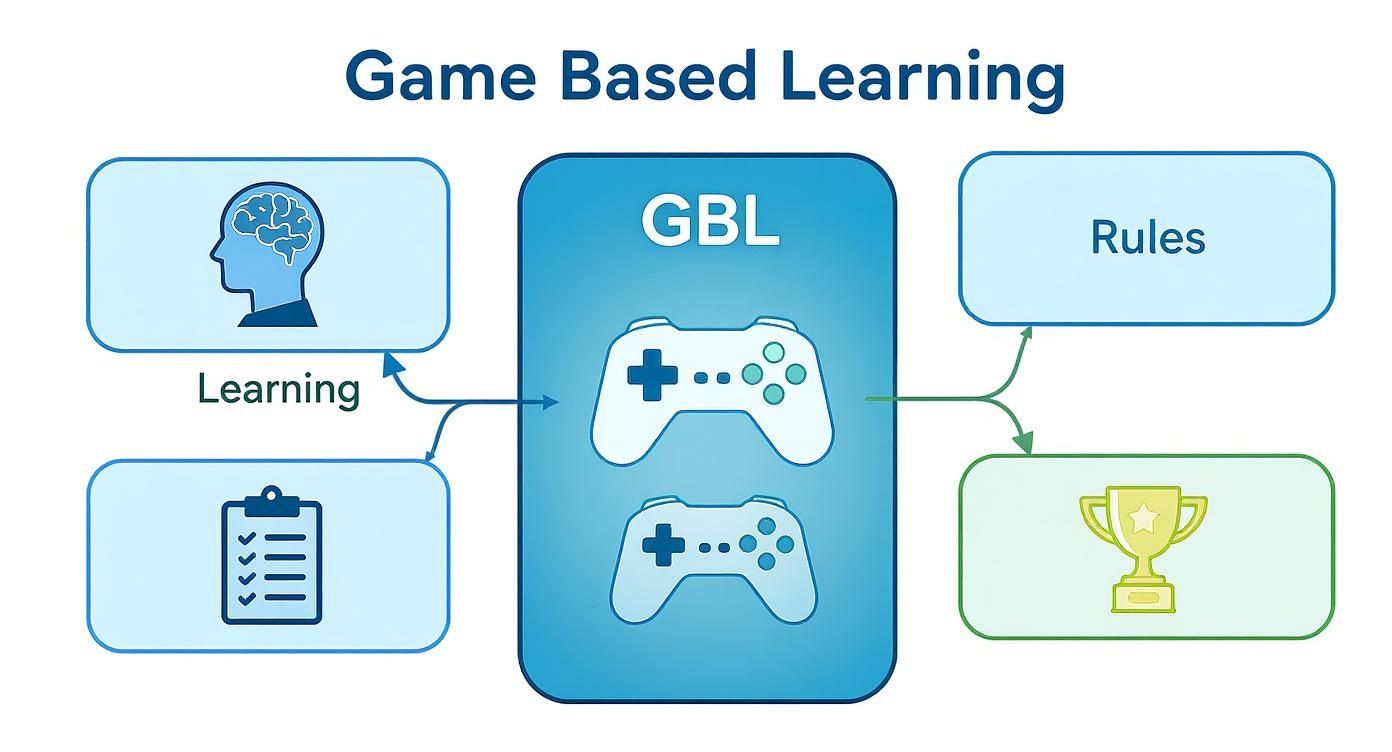
As you can see, the learning objective is the central pillar, supported by clear rules and a motivating goal. Everything works together to drive the educational mission forward.
Game Based Learning vs Gamification vs Play
It’s easy to get GBL mixed up with similar-sounding concepts like "gamification" or just "play." They're related, but the goals and methods are fundamentally different. Let's clear up the confusion.
This table breaks down the key distinctions.
| Concept | Primary Goal | How It Works | Example |
|---|---|---|---|
| Game-Based Learning | Teach a skill or concept. | The entire game is the lesson. Learning is required to progress and win. | A history strategy game where you must understand real events to succeed. |
| Gamification | Motivate behavior in a non-game setting. | Adds game elements like points, badges, or leaderboards to an existing task. | An app that awards you points for completing homework assignments. |
| Play | Spontaneous, child-led exploration. | Unstructured and freeform, with no predetermined learning objectives. | Building a tower with blocks just for fun. |
In short, GBL uses a whole game as the lesson. To beat a physics puzzle game, you must apply the principles of physics. The learning isn't a bonus; it's the key to winning.
This active-learning philosophy connects GBL to the broader world of immersive learning, which often uses technologies like AR and VR to create powerful educational simulations. Both approaches are built on the idea that active participation is far more effective than just memorizing facts. It's this shift from passive to active that makes GBL such a powerful tool in modern education.
The Science of Why Learning Through Play Works
Ever notice how a kid can stay glued to a video game for hours but tunes out a textbook in minutes? It's not a lack of focus; it's brain chemistry at work. Game-based learning hooks directly into the core psychological and neurological systems that drive our motivation, engagement, and ability to remember things.
It’s not just about making lessons "fun." It’s about aligning the learning process with how our brains are naturally wired to learn.
The secret ingredient here is dopamine, the neurotransmitter our brain releases when we feel pleasure and a sense of reward. Every time a player solves a tough puzzle, beats a tricky level, or discovers something new, their brain gets a little hit of dopamine. This creates a powerful feedback loop that makes them want to keep playing—and, by extension, keep learning. Games feel so compelling because they tap into this fundamental reward system.
Creating a Safe Space for Failure
Traditional classrooms often treat mistakes as something to be avoided, which can create a real fear of failure. Games flip this idea on its head. They reframe failure as a normal, even essential, part of learning. When you fail a level in a game, you don't get a bad grade. You just get another shot, this time armed with what you learned from your last attempt.
This "safe to fail" environment is incredibly important for building resilience. It takes the pressure off and encourages learners to experiment with different strategies without worrying about negative consequences. This cycle of trying, failing, and adapting is precisely where deep, lasting understanding is forged.
In a well-designed learning game, mistakes aren't setbacks; they're data. Each failed attempt gives the player valuable information, turning the learning journey into a process of discovery rather than a test of existing knowledge.
This approach lines up perfectly with how we master any complex skill in the real world. By lowering the stakes, game-based learning encourages the kind of persistent problem-solving that leads to true mastery. These principles are really the foundation of all good interactive learning, where getting your hands dirty drives the best results.
Balancing Challenge and Skill with Flow
One of the trickiest parts of teaching is keeping students in that sweet spot—challenged enough to be engaged, but not so overwhelmed that they give up. This is where the psychological concept of the flow state comes into play. You know that feeling when you're completely absorbed in an activity? Time just melts away, and the task feels both demanding and perfectly achievable. That’s flow.
Good learning games are masters at creating and maintaining this state. They pull it off with a few key mechanics:
- Adaptive Difficulty: The game gets harder or easier based on how you're doing, making sure the challenge always feels just right.
- Clear Goals: You always know exactly what you're supposed to do next. This provides a clear sense of purpose and keeps you moving forward.
- Immediate Feedback: The game instantly tells you if your actions worked or not, letting you adjust your strategy on the fly.
This delicate balancing act also helps manage a learner's cognitive load—the amount of mental effort they're using at any given moment. By breaking information into manageable chunks and giving constant feedback, games prevent the mental burnout that shuts down learning. If you're curious about the research behind this, there are some great studies on how gamification in education can boost learning engagement.
Ultimately, by working with our natural brain functions, game-based learning turns education from a passive chore into an active, rewarding adventure.
What Makes a Great Learning Game?
A truly great learning game doesn’t feel like a lesson at all—it feels like an experience. That magic isn't an accident. It comes from a handful of core design principles that weave learning and gameplay together so tightly you can't tell where one ends and the other begins. So, let’s get into the how. What are the essential ingredients for a learning game that actually works?
It all starts with a laser-focused learning goal. Before anyone even thinks about characters or levels, the creator has to answer one simple question: "What, exactly, will the player be able to do after this game?" This becomes the game's true north, guiding every rule, challenge, and piece of the story.
Think of it this way: if you’re designing a game to teach fractions, the goal isn't just "learn fractions." It's much sharper: "The player will be able to combine fractions with different denominators to solve puzzles." With that clarity, you ensure every part of the game serves that single educational purpose.
Weaving Learning into a Compelling Narrative
Once you know the destination, you need a vehicle to get there. A compelling story gives players a reason to care about the challenges ahead. Instead of just solving abstract fraction problems on a worksheet, what if the player is a cosmic chef, mixing fractional ingredients to blend smoothies for a lineup of weird alien customers?
This narrative approach does two incredibly important things:
- It provides a memorable framework that helps new information stick.
- It sparks intrinsic motivation—the desire to succeed comes from within the story, not just from getting the right answer.
The story turns a boring math exercise into an adventure. You’re pushed forward by the desire to serve that next goofy-looking alien, and the learning just happens naturally along the way.
Balancing Challenge with Skill
The secret sauce of any addictive game is its ability to keep you in that perfect sweet spot—the "zone of proximal development." It's where the task is tough enough to be interesting but not so hard you want to throw your keyboard across the room. This is done with carefully scaffolded difficulty.
A good learning game is like a great personal tutor. It senses when you're struggling and offers a hint, but it also knows when to ramp up the difficulty just as you start to get the hang of things. You're always engaged, never overwhelmed.
In our space-chef fraction game, the first few levels might just involve combining simple halves and quarters. Once the game sees you’ve mastered that, it starts throwing in more complex recipes with trickier denominators. This adaptive challenge keeps learners of every skill level locked in and motivated to improve.
This is why the solutions segment of the market, which includes gamified learning platforms, holds such a dominant revenue share. More and more schools and companies are seeing the value in these adaptive tools. For a deeper dive, check out this game-based learning market report.
The Power of Instant, Constructive Feedback
Last but not least, no learning game works without a great feedback system. In a traditional classroom, feedback might not come for days. In a game, it’s instant. When the space chef gets the recipe right, the alien beams with joy. Get it wrong, and the smoothie might explode. You immediately get a clear, visual signal that something needs to change.
But the feedback has to be constructive. Instead of just a big red "X," a good game might highlight the wrong ingredient or offer a quick tip. This simple shift turns mistakes from frustrating dead-ends into valuable learning moments, encouraging players to figure out what went wrong and try again. This constant loop—action, feedback, adjustment—is the real engine driving mastery in game-based learning.
Game Based Learning in the Real World
The theory behind game-based learning is solid, but what does it actually look like when the rubber meets the road? You might be surprised. It’s not just a niche tool for K-12 classrooms. GBL is actively training professionals in high-stakes fields, sharpening leadership skills in the corporate world, and making complicated subjects click for learners of all ages.
Think about it this way: it’s one thing to read about a historical event, but it’s another to command an army in a strategy game where your decisions have to align with real historical limitations. You can study anatomy diagrams all day, but performing a simulated surgery where every choice has immediate, visible consequences? That’s a whole different level of learning.
This is the real magic of game-based learning—it turns passive knowledge into active, usable skills.
High-Stakes Training in Specialized Fields
In professions where mistakes can have serious consequences, GBL offers an indispensable, risk-free training ground. Aspiring surgeons, for instance, can now use advanced surgical simulators to practice intricate procedures hundreds of times before they ever set foot in an operating room. These aren't simple video games; they replicate the feel of real tissue and the pressure of a ticking clock, building muscle memory and critical thinking in a safe, controlled setting.
This approach is also a cornerstone in aviation—flight simulators have been used for decades—and in military training for complex strategic planning. Simulation-based games are incredibly effective, making up a 34.1% revenue share in the higher education market, largely because they work so well for STEM and health-science programs where hands-on experience is critical. You can dig deeper into this trend in the higher education game-based learning market report.
The goal of these simulations isn't just to entertain. It’s to build mastery through repetition and immediate feedback. Each failure is a low-cost lesson, and each success reinforces the correct procedure, truly preparing professionals for the demands of their jobs.
Corporate Leadership and Skill Development
Businesses are also catching on, swapping out stale PowerPoints for dynamic game-based training. Instead of sitting through a lecture on leadership, teams can jump into management simulation games. Here, they have to navigate tough conversations, allocate a tight budget, and make strategic calls that affect the entire team. The game gives instant feedback, showing them exactly how their leadership style impacts morale and project outcomes.
This method is proving versatile for all sorts of corporate needs:
- Sales Training: Games that simulate client calls and tricky negotiation tactics.
- Compliance and Ethics: Scenarios that drop employees into realistic workplace dilemmas, forcing them to make ethical choices.
- Onboarding: Interactive games that introduce new hires to company culture and processes in a way that’s actually engaging.
Making Abstract Concepts Concrete
Maybe the most common and powerful use of GBL is its ability to make abstract topics feel real and memorable. Platforms like Minecraft: Education Edition let students build historical landmarks, wander through the structure of a cell, or even write code to automate tasks inside the game. Suddenly, a flat image in a textbook becomes a 3D, interactive world they can explore.
This is exactly where a platform like EarthChasers shines. It uses real-world geographic data to transform environmental science and geography into a hands-on adventure. Instead of just reading about deforestation, students can fly over a virtual ecosystem and see the impact of their choices firsthand.
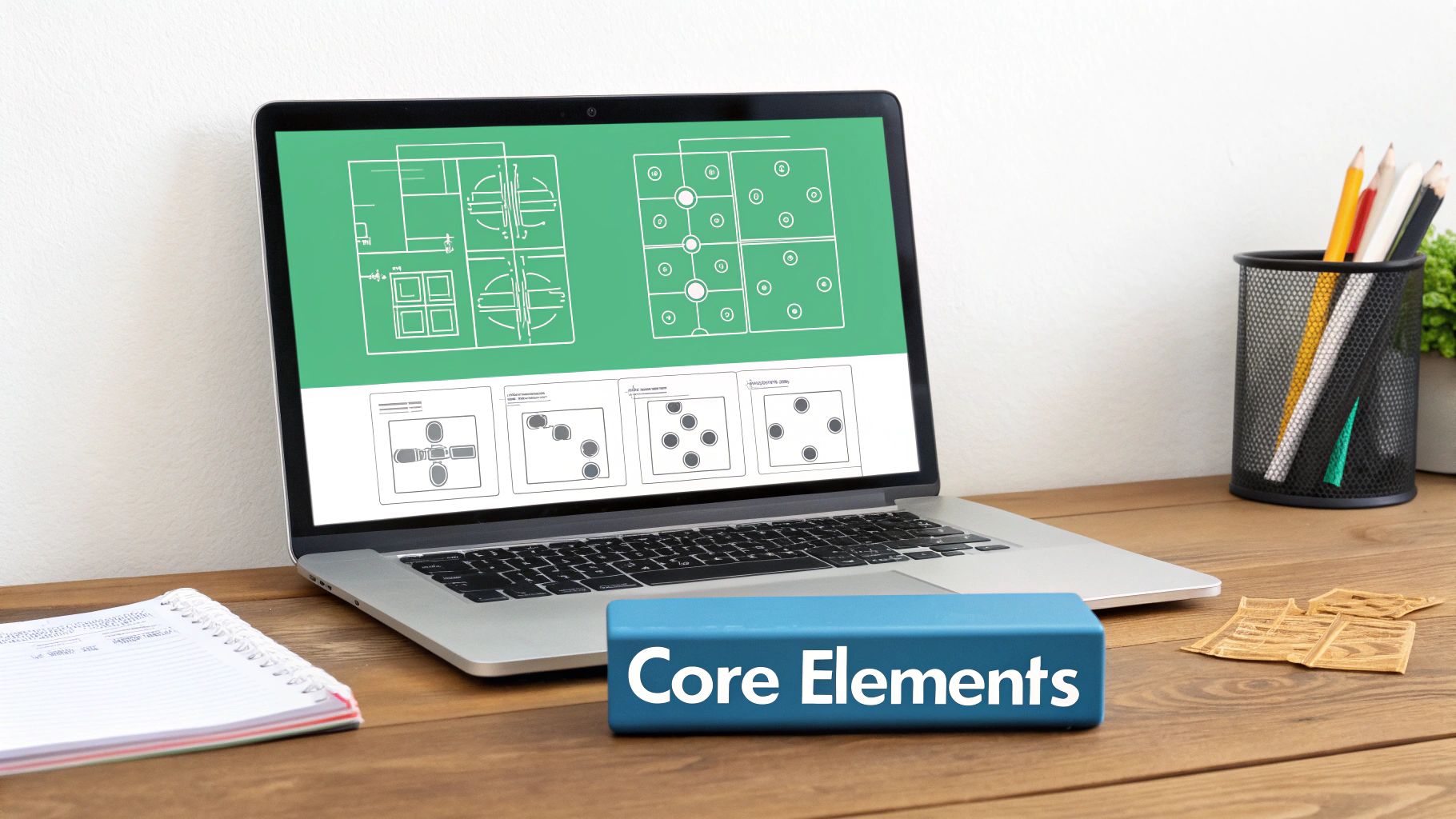
This screenshot shows how EarthChasers blends photorealistic 3D maps with engaging gameplay, inviting you to explore the world from a new perspective. By embedding challenges directly into this immersive environment, the game makes learning an active pursuit. Abstract concepts like longitude, topography, and environmental impact become tangible things you can interact with. The gameplay loop—explore, identify, solve—directly reinforces curriculum goals, making geography a subject you experience, not just memorize.
How to Implement Game Based Learning
Alright, let's move from theory to action. This is the fun part. Bringing game-based learning into your classroom or training program doesn't have to be some monumental task that requires you to tear everything down and start over. Think of it as a gradual process. With a clear, step-by-step plan, you can start small and build something that genuinely connects with your learners.
The most important thing? Be intentional. A game should never feel like a random, disconnected activity you just tack on at the end of the week. It needs to be a purposeful tool, fully integrated to serve a specific educational goal. Let's walk through how to make sure your chosen game actually enhances learning, instead of just distracting from it.

H3: Start With Your Learning Goals
Before you even glance at a game or a platform, get back to basics. Ask the fundamental question: What must my students learn? Get crystal clear on your learning objectives. Are you trying to get them to master multiplication tables? Understand the intricate dance of the water cycle? Or perhaps practice making tough ethical decisions in a simulated environment?
Your learning goal is your North Star. It guides every single decision you'll make, from which game you pick to how you’ll know if it worked. Without that clear target, even the most addictive game is just a fun way to pass the time.
H3: Understand Your Audience
Next up: who are you teaching? What are they into, what can they already do, and what gets them excited? The coolest game on the planet will completely bomb if it doesn't resonate with the people playing it.
Think about these key things:
- Age and Developmental Stage: A game that works for a third-grader is going to look wildly different from a simulation built for corporate leadership training.
- Prior Knowledge: Are your learners coming in cold, or do they already have a foundation to build upon?
- Interests and Motivations: Do they thrive on competition? Or do they prefer collaboration, storytelling, or just building cool stuff? Matching the game’s style to their passions is the secret sauce for engagement.
H3: Choose the Right Tool
Okay, now that you have your goals and audience figured out, you can start the hunt for the right tool. This is a make-or-break moment where a lot of well-meaning GBL plans fall apart. There are a ton of options out there, so you need a smart way to sort through them.
Don't just look for a "fun" game; look for the right learning instrument. The best GBL tools are built with pedagogy at their core, ensuring that the gameplay mechanics directly reinforce the skills you want to teach.
Think about whether it makes more sense to build something custom, buy an off-the-shelf game, or maybe adapt one you already know. Platforms like Minecraft: Education Edition offer amazing flexibility, while other specialized games can target a very specific skill with laser precision. For a broader look at what's available, exploring a guide to educational technology tools for teachers can give you some great ideas.
Before you commit, it helps to have a checklist to evaluate your options.
Checklist for Choosing a GBL Tool
Use this table to systematically evaluate different game-based learning tools. It helps you move beyond the "fun factor" and focus on what truly matters for your educational goals.
| Evaluation Criterion | Key Questions to Ask | Yes/No/Partial |
|---|---|---|
| Alignment with Goals | Does the core gameplay directly teach or reinforce my learning objectives? | |
| Audience Appropriateness | Is the game's theme, complexity, and content suitable for my learners' age and skill level? | |
| Engagement Factor | Does the game have compelling mechanics (e.g., challenge, story, rewards) that will motivate my audience? | |
| Ease of Implementation | How much setup is required? Is it easy for learners to get started? Does it run on our available devices? | |
| Assessment & Feedback | Does the game provide clear feedback to the learner? Can I track progress or see performance data? | |
| Curriculum Integration | Can I easily fit this game into my existing lesson plans and curriculum structure? | |
| Cost & Scalability | What is the total cost (including subscriptions or licenses)? Can it scale to all my learners? |
By running your top contenders through this checklist, you can make a much more confident and effective choice.
H3: Integrate into Your Curriculum
This is a big one. One of the most common mistakes is to treat a learning game like a reward or a "Fun Friday" activity. For GBL to be truly effective, you have to weave it right into the fabric of your curriculum. You need a plan for how the game will introduce a new concept, reinforce something you've taught, or even assess what students know.
For instance, you could kick off a new unit with a game, letting students build an experiential foundation before you dive into the formal lessons. On the flip side, a game could be the perfect tool for practice and repetition after a concept has been taught in a more traditional way.
H3: Debrief and Assess Learning
The learning doesn’t stop when the game is over. In fact, some of the most powerful lightbulb moments happen in the conversation after the game. A structured debriefing session is absolutely critical. It’s where you help learners reflect on what they just did and connect their in-game accomplishments to real-world knowledge.
Try asking some guiding questions to get the ball rolling:
- "What strategy worked best for you on that level, and why?"
- "How does the challenge you faced in the game relate to the problem we talked about in class yesterday?"
- "What did you learn from the times you failed or had to restart?"
This reflection is what solidifies the learning and makes it stick long after the screen goes dark. It’s the final step that turns simple play into deep, meaningful understanding.
Navigating Common Challenges and Misconceptions
Embedded content
While the benefits of game-based learning are clear, bringing it into a classroom isn’t always a straight shot. Like any powerful teaching tool, it comes with a few common hurdles and misunderstandings that can slow things down. Tackling these issues head-on is the key to getting the most out of it.
One of the biggest concerns for parents and teachers alike is screen time. It's a fair point. But the conversation needs to shift from the quantity of screen time to the quality of the interaction. An hour spent solving tough problems in a well-designed educational game is a world away from an hour of passively watching videos. The goal is to make sure the game adds to the lesson, not just distracts from it.
Another major challenge is getting buy-in from administrators or stakeholders who might see games as just play. You have to prove the value. This means tracking metrics that go beyond just "fun"—things like better test scores, higher engagement, or improved retention of difficult concepts. Presenting hard data helps reframe GBL from a fun novelty into a smart educational strategy.
Debunking Common GBL Myths
Beyond the practical stuff, a few stubborn myths keep a lot of educators from even trying game-based learning. It’s time to set the record straight.
The most common myth? Games are just for kids. That couldn't be more wrong. Complex simulations are used to train surgeons, military leaders, and executives for high-stakes decisions. These "serious games" prove that game mechanics are incredibly effective for teaching complex skills to adults in a safe, repeatable setting.
The core mechanics of a good game—clear goals, immediate feedback, and adaptive challenges—are universal principles of effective learning. They work just as well for a five-year-old learning phonics as they do for a CEO practicing crisis management.
Another big misconception is that GBL is the same thing as gamification. They're related, but different. It helps to understand the difference between gamification and game-based learning, as GBL uses a complete game as the teaching tool, while gamification just adds game-like elements (like points or badges) to other activities. Knowing the difference is crucial when you're advocating for a true GBL approach where the learning is baked right into the gameplay.
Practical Solutions for Implementation
Getting past these issues requires a proactive plan. You don't have to fix everything at once. Instead, focus on a few key steps to build momentum and show people what's possible.
- Structure Debriefing Sessions: The learning doesn't stop when the game ends. Always make time for reflection. This helps students connect what they did in the game to real-world ideas.
- Start Small and Measure: You don't need a huge, district-wide launch. Start with a single classroom or even just one unit. Track the results carefully, and use that success story to get more people on board.
- Prioritize Pedagogical Alignment: Make absolutely sure the game's core activities directly support your learning goals. A fun game that doesn't teach the right skill is, at the end of the day, just a distraction.
By anticipating these challenges and clearing up the myths, you can build a strong foundation for a successful GBL program—turning potential roadblocks into opportunities for deeper, more engaging learning.
Got Questions About Game-Based Learning?
Even with a clear plan, a few questions always pop up when you're ready to dive into game-based learning. Let's tackle the most common ones head-on so you can move forward with confidence.
Think of this as the final check-in before you launch, clearing up any last-minute uncertainties.
GBL vs. Gamification: What's the Difference Again?
This is easily the most common point of confusion, so it’s worth a quick refresher. The easiest way to tell them apart is to think about the role of the game.
- Game-Based Learning (GBL) is when the learning happens inside a complete, self-contained game. You have to master the educational content to win or progress.
- Gamification is when you take game-like mechanics—think points, badges, or leaderboards—and add them to a normal, non-game activity to boost motivation.
A history game where you build and run a civilization? That’s GBL. A homework app that awards you points for completing math problems? That’s gamification.
How Do I Actually Measure Learning Inside a Game?
This is a big one. Measuring progress is essential, and it goes way beyond just seeing who "won." Good educational games have assessment tools baked right into the experience, tracking a player's actions, decisions, and skill mastery as they play.
The best games offer a teacher or admin dashboard. This data doesn't just show if a student got an answer right—it reveals how they tackled the problem, which strategies they tried, and exactly where they struggled.
This is often called "stealth assessment," and it gives you a far richer, more authentic picture of a student's thought process than a multiple-choice quiz ever could.
Are There Any Good GBL Options That Don't Cost a Fortune?
Absolutely. You don't need a massive budget to get started. Plenty of incredible platforms offer free versions or are completely free for educators.
Here are a few ways to get going without breaking the bank:
- Adapt What's Already Out There: Many popular commercial games, like Minecraft, offer dedicated educational editions that are perfect for classroom use.
- Explore Free Platforms: Tools like Kahoot! or Quizlet offer simple, game-like quizzes that are great entry points.
- Look for "Freemium" Models: Lots of GBL companies provide robust free tiers. These are perfect for running a small pilot in your classroom before you think about a bigger investment.
How Can I Get My Boss or Principal on Board?
When you're trying to convince leadership, you have to speak their language: results and data. Don't pitch GBL as a "fun new activity." Frame it as a strategic tool designed to improve specific outcomes, like engagement, test scores, or skill retention.
The best approach is to start small with a controlled pilot program. Track your key metrics before and after. When you can walk in with hard evidence showing a clear return on investment, the conversation changes completely. It also helps to point out GBL's proven track record in high-stakes fields like corporate training and medicine—that quickly busts the myth that it's "just for kids."
Ready to see these principles in action? EarthChasers brings geography and environmental science to life with immersive 3D gameplay. Students explore photorealistic landscapes, tackle global challenges, and discover the world in a way that feels like a true adventure. See it for yourself at https://earthchasers.com.